
Concrete Pavers
Concrete pavers in Woodland Hills.
The practical choice. Stronger than the slab in your driveway, colored all the way through, and priced so you can cover real square footage without flinching.
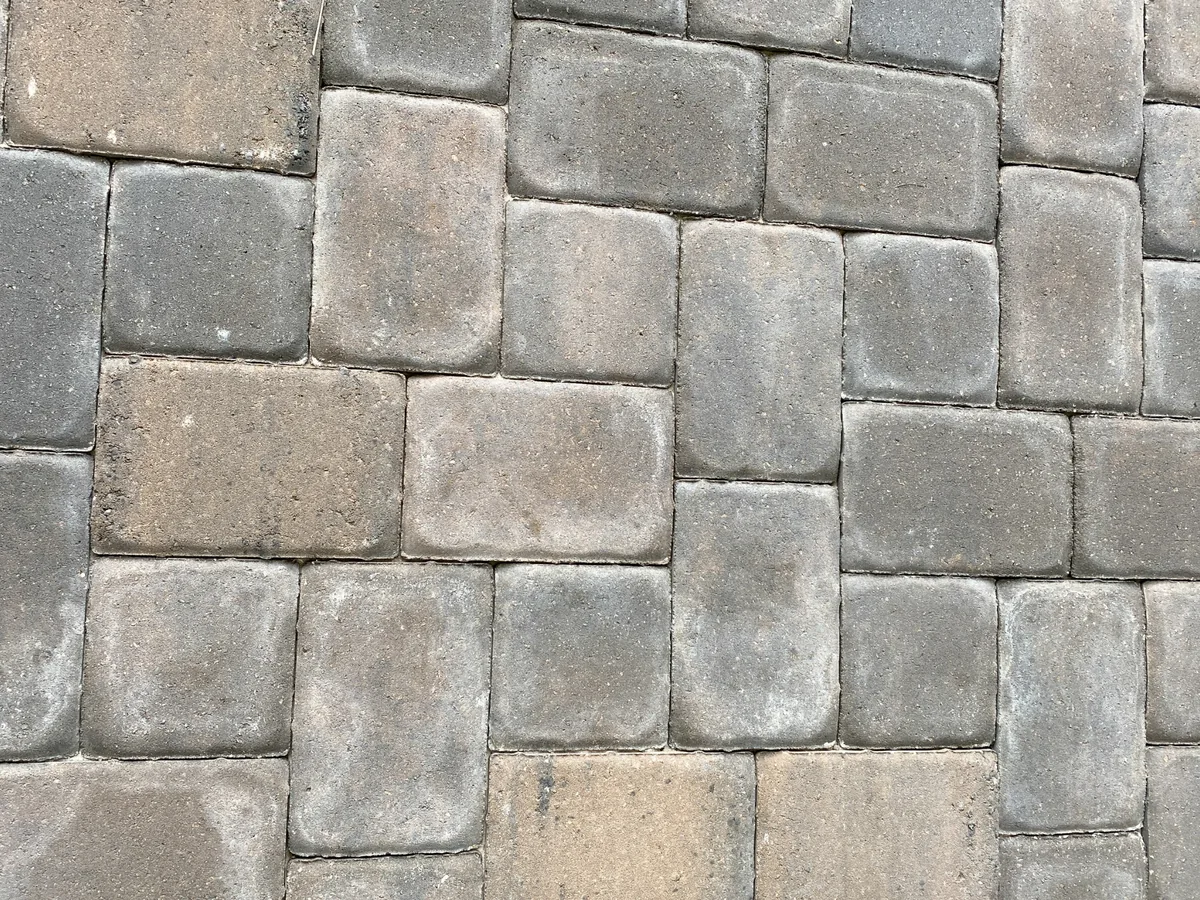
What you are actually buying
People hear "concrete paver" and picture the same material as the cracked driveway they are trying to replace. It is not. A paver is manufactured, not poured on site. A stiff, very low water concrete mix is compressed in a mold under high pressure and then cured under controlled conditions. Squeezing the water out and the density up produces a unit that is substantially stronger in compression than the ready-mix that goes into a residential slab, and far less absorbent. On top of that, the pigment is blended into the mix, so the color exists through the whole body of the paver rather than sitting on the face.
That last detail is what separates a paver from stamped concrete, and it is the reason this material makes so much sense in Woodland Hills specifically.
The heat argument, with a number attached
On September 6, 2020, the weather station at Pierce College, right here in Woodland Hills, recorded 121 degrees. That is the all-time high for all of Los Angeles County, and it beat the previous record of 119 set in 2006. This is not an average neighborhood for sun exposure. Santa Ana events push hot, dry air across the west Valley for days at a stretch, and the UV load is high.
Stamped concrete puts its color and its texture in a thin surface layer that depends on a sealer to survive. Under this kind of exposure that sealer chalks, the color washes toward gray, and the honest maintenance answer is resealing every few years for the life of the surface. A concrete paver has nothing to lose. Sun works on the top millimeter of a unit whose color goes all the way down, so what you see after fifteen years is a slightly softened version of what you bought, not a different surface.
There is a second benefit that matters south of Ventura Blvd. Concrete pavers are noncombustible. Parts of the foothills sit inside the City's Very High Fire Hazard Severity Zone, and hard, nonflammable ground cover close to the structure is a genuine part of a defensible space strategy rather than a decorating decision.
Pavers versus a poured slab on clay
Much of the flat part of Woodland Hills sits on clay and clay loam, with pockets of easier loam and sandy loam between them. Clay takes on water, expands, then dries out and contracts. Anything rigid laid across it eventually has to relieve that stress somewhere, and in a poured slab that means a crack. Control joints steer where the crack happens, they do not prevent it, and once it opens it runs across the whole pour where everyone can see it.
An interlocking paver surface handles the same soil movement differently. The field is thousands of small units sitting on a flexible compacted base, with sand-filled joints between them. When the ground below shifts, the surface flexes and the joints take up the difference. Nothing has to fracture. And when a single unit does get damaged, stained by an oil leak, or undermined by a tree root, that one paver is lifted and replaced. There is no patch that never quite matches, because the replacement is the same unit from the same line.
| Consideration | Poured or stamped concrete | Concrete pavers |
|---|---|---|
| Price on day one | Lower | Higher |
| Reaction to clay movement | Cracks across the pour | Joints flex, surface stays intact |
| Color under strong sun | Surface coat fades, needs resealing | Pigment runs through the unit |
| Fixing damage | Patch or resurface a whole section | Swap the affected units |
| Utility access underneath | Cut and repour | Lift, dig, relay the same pavers |
| Use straight away | Cure time before traffic | Walk and drive on it the same day |
Find out what your project costs.
The contractor measures the area, looks at the soil and the drainage, and puts one fixed number in writing.
Get a free quoteGet a price for your concrete paver project
Two fields is all we need. We call or text you back with a straight number, no card and no pressure.
Rather just talk? Call (818) 867-8109. Your details go to one licensed contractor. How we handle them
Where concrete pavers earn their keep around here
- Replacing tired ranch-tract driveways. The post-war neighborhoods north of the boulevard are full of original straight drives that have done their time. A concrete paver replacement is the highest-impact exterior change most of those houses can make.
- Covering serious square footage in Walnut Acres. On the big former orchard parcels the paver line is a large share of the bill, and standard concrete pavers let a long approach drive and a large terrace happen in the same season.
- Backyard patios and pool decks. Cooler than dark poured concrete, grippier when wet, and repairable next to a pool without heavy demolition.
- Side yards and utility paths. Cheap enough to justify, and easy to lift if a plumber ever has to reach the line underneath.
- Hillside terraces. Pairs naturally with segmental retaining wall block, which is manufactured the same way and comes in matching colors.
- Permeable installations. Open-joint permeable pavers over a stone reservoir give clay-soil lots somewhere to put runoff instead of sending it to the neighbor.
What you can choose
Concrete pavers are not one product. Standard rectangular units in a blended earth tone are the default and the value leader. Tumbled pavers have their edges knocked off in a drum so they read older and softer, which suits the ranch and Spanish-influenced houses common in Woodland Hills. Large-format slabs, some of them two feet across, give a clean modern look that works on the newer builds up the hill, though they want a very flat base. Slate-textured and shot-blasted faces add surface interest. Permeable lines are made with deliberately wide joints. All of them install over the same base system the contractor uses for every concrete paver installation in Woodland Hills, so the choice is aesthetic and budgetary rather than structural.

How long they last and what they need
A concrete paver surface installed over a properly built base is a multi-decade proposition, and the base is doing most of that work. Upkeep is genuinely light: sweep, rinse a few times a year, and top up joint sand when it settles, roughly every two years. Sealing is optional and mostly about deepening color and resisting stains near a grill or a parking spot. If anything ever does go wrong, the fix is local, not total.
Which unit you pick shows most on a wide patio field, covered on patio work across Woodland Hills.
Formats and finishes are shown in the paver styles gallery.
Related pages
What people ask about the unit
What are concrete pavers?
They are individual paving units pressed from a dense, low-water concrete mix under high pressure, then cured. That process makes them considerably stronger in compression than the concrete in a typical poured driveway, and the color pigment is mixed through the whole unit instead of being brushed on top.
How much do concrete pavers cost in Woodland Hills?
They are the value pick among pavers, but the paver is only part of the bill. The base, demolition, drainage, edge restraint and labor are priced with it, so the contractor gives you one written figure after measuring the area.
Are concrete pavers better than a poured concrete slab?
On the clay flats here, yes. A slab is one rigid plate that has to crack somewhere as clay soil swells and shrinks, and that crack shows across the whole pour. Pavers are thousands of small units over a flexible base, so ground movement is absorbed by the joints. Repairs are also a unit swap rather than a patch.
Will concrete pavers fade in this heat?
Far less than stamped concrete does. The color runs through the full thickness of a concrete paver, so surface wear does not expose a different shade underneath. That matters in a neighborhood where Pierce College logged 121 degrees in September 2020 and Santa Ana winds bring long stretches of hard, dry sun.
Can I put concrete pavers over my existing slab?
Sometimes, if the slab is sound, properly drained, and the added height does not create a threshold or drainage problem at the house. More often on older Woodland Hills tracts the existing slab has already moved with the clay beneath it, and overlaying it just passes that movement up to the new surface. The contractor tells you which situation you have after looking at it.